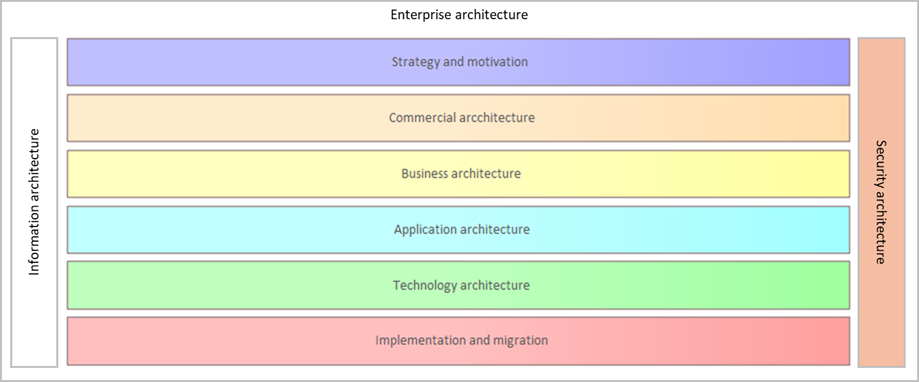
Architecture is the description of the fundamental structure for ”something complex” like a system, organization or enterprise. Within an enterprise architecture, there are several sub-architectures with different focuses, and beneath these, often models aimed at different areas.
Architectures are driven by quality and risk, hence it is the architect’s responsibility to inject quality and reduce risk over time. The quality and risk is achieved by first understand and then address problems and challenges. The way to understand is done based on models which help the communication and high-lighting of problems.
In an enterprise architecture, top layers ”drive” layers below and the layers below answer by ”supporting” or ”serving” the layers above it. You can view the top layer (Strategy and motivation) as ”the head” and the layers below the head as ”the body”. Sometimes, the Information architecture is viewed as ”the heart” of the body, based on its central function.
Different layers and sub-architectures to the enterprise architecture:
- Enterprise architecture – overall/holistic view of the entire organization
- Strategy and motivation – the head that drives the body, i.e. goals etc
- Commercial architecture – architecture of commercial components
- Business architecture – optimization of business functions
- Information architecture – control over information and databases
- Application architecture – IT components supporting the business
- Technical architecture – infrastructure such as servers and networks
- Security architecture – infrastructure to ensure proper access
- Implementation and migration – the movement forward
Enterpise architecture is thus the broad, generic architecture that encompasses an entire group or organization. It is often divided into sub-architectures, each with its own focus area. Break-down of architecture is subsequently done through design. See the relationship between architecture and design in the description below.
Videos exemplifying the EAS framework can be found here: EAS YouTube channel
Relationship between architecture and design
A commonly recurring question is what the difference is between architecture and design. From a broader perspective, architecture can be said to be ”design on a fundamental level” and thus falls under design. From a narrower perspective, when one simply says ”design,” it refers to ”shaping for a given platform,” e.g., JSON, Java, SQL Server. The design (e.g., JSON) then traces and details things in architectural descriptions such as the example <<Messages>>.
- Architecture – fundamental foundations that incorporate quality
- Design – shaping for a specific given platform, often with architectural elements as input