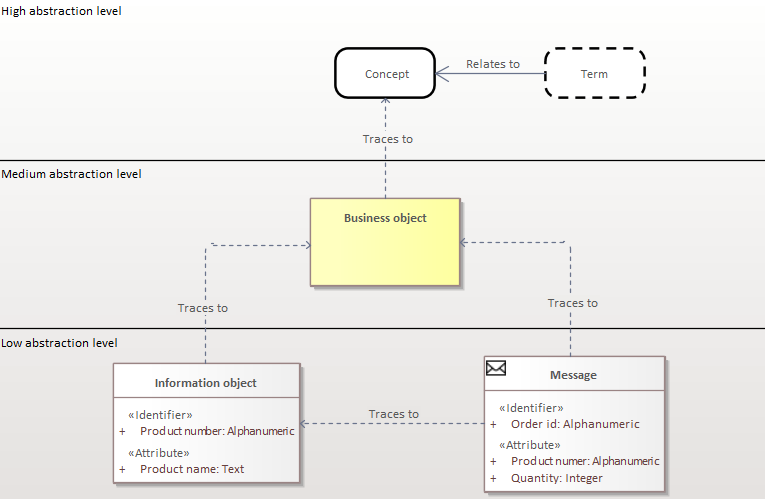
Information architecture aims to capture and break-down information into usable pieces. It often starts with terminology modeling that captures concepts and terms or with business processes that express the need for ”things” in their flows, captured as business objects. These concepts, terms and business objects are broken down into information objects and messages that in turn are related to their origins in order to establish tracebility.
- Terminology models – define the language that shall be used
- Business object models – define ”things” used in business/processes
- Information object models – the normalized ”truth” for information
- Message models – abstractions for information sent between systems
The lower you go in the different information architecture models, the more detailed you get, i.e. the less the abstraction level gets. At the same time, once you detail/break-down one layer to a more detailed level you establish a trace relationship to the ”source” from where this detailed information comes from. It is this kind of structured tracing that makes EAS stand out – because the EAS has a pre-defined way for how to trace information, you are then able to analyze and rely on your documentation. If strict rules like the EAS are not applied, this kind of analysis will never be possible.